
The causes of the hyperinflation
The post-war devaluation of the mark was rooted in the decision taken by Imperial Germany in 1917 to finance the massive cost of the First World War through a combination of borrowing and printing money. The heavy reparations imposed on Germany through the Treaty of Versailles placed a further burden on the already struggling German economy.
After Germany had fallen behind with its reparations payments in 1923, French and Belgian troops occupied the industrial Ruhr area. The German government called on its citizens to offer passive resistance and continued paying the wages of any workers that went on strike. The government financed this campaign with further money printing.
The collapse of money
The vast expansion of the money supply caused by these policies produced a situation in which money lost its value within hours. This led to companies paying its workers daily to enable them to make basic purchases. Instead of wallets, ordinary people went shopping with wheelbarrows – not for their purchases, but to transport the amount of money that was required to make them.
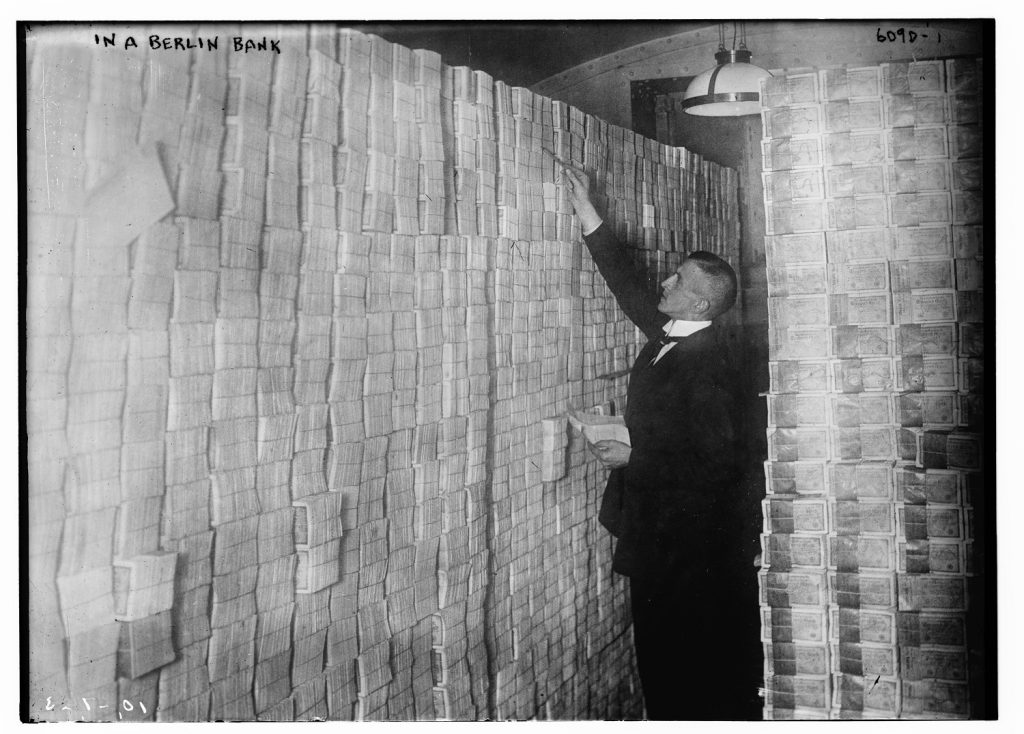
Worthless: this pile of banknotes in the cellar of a Berlin bank in 1923 was not worth the space it occupied (source: Bain News Service, publisher, public domain, via Wikimedia Commons)
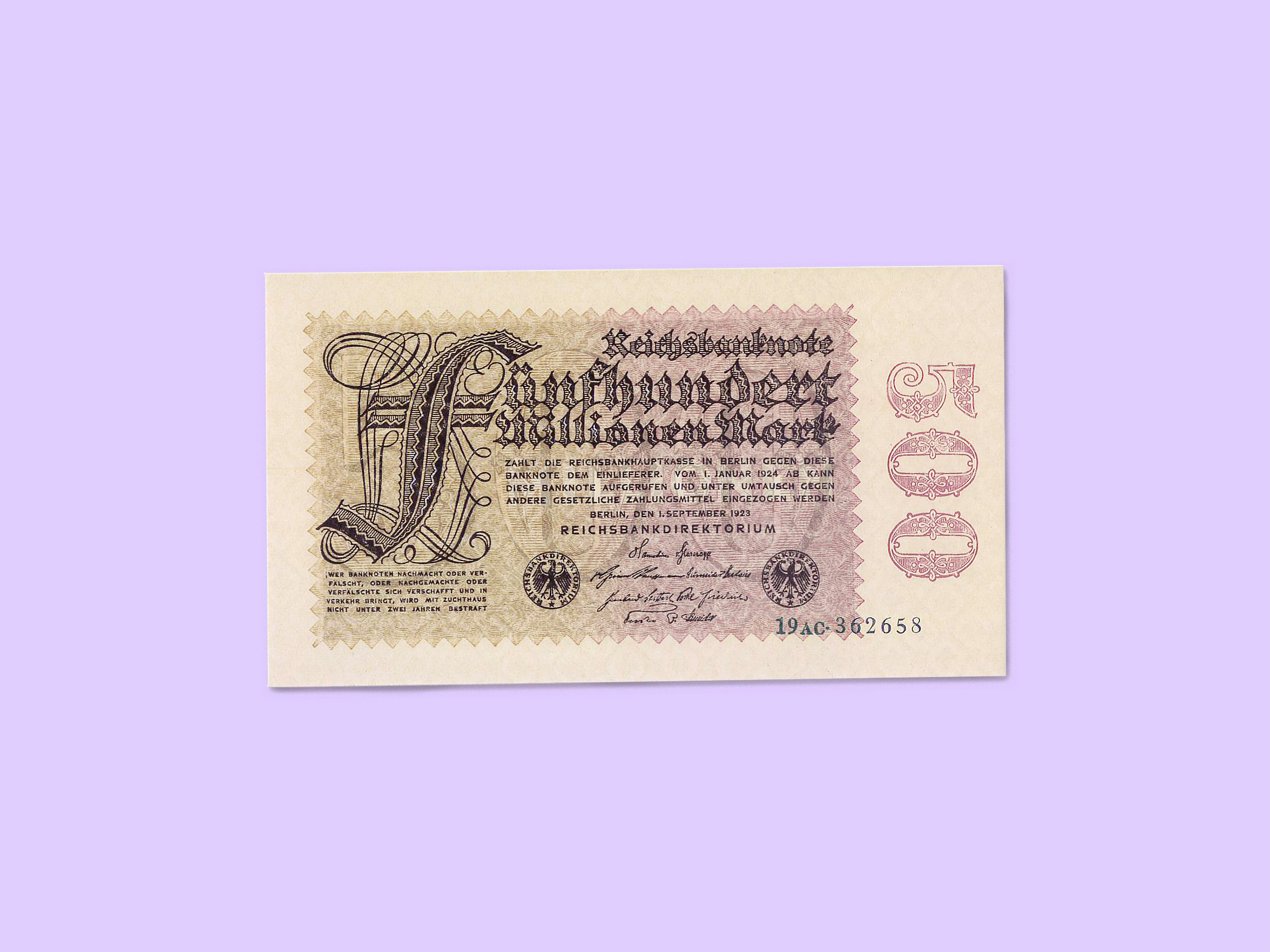
The 500-million mark banknote on display in the exhibition of the Deutschlandmuseum was issued on 1 September 1923. Despite its astronomical face value, after a few weeks its owner would have been lucky to be able to redeem it for a few loaves of bread or a tram ride.
The social and economic impact of inflation
The impact of inflation was immediate. Paper money and coins could no longer be trusted as a means of payment and the money economy was replaced by a system of barter.
Hyperinflation also created inequality. Whilst the middle classes saw the value of their savings wiped out and descended into poverty, the owners of assets – property, production and land – weathered the storm. Debtors, including the state, saw the value of their debt wiped out almost overnight.
The end of inflation
A currency reform implemented in November 1923 replaced the worthless paper Reichsmark with the new Rentenmark tied to the value of land and property values. The old mark was exchanged at the ratio of 1 billion to 1.
By ending passive resistance in the Ruhr and introducing a policy of retrenchment, the German government was able to stabilize prices and win back trust in the new currency. This laid the foundation for a period of relative prosperity and political stability in the mid-1920s.
The legacy of hyperinflation
Although the currency reform stabilized the economy, the events of 1923 resulted in a collective trauma. The perception that democracy was fundamentally unable to ensure economic stability strengthened the cause of political extremists and made many ordinary Germans susceptible to their message. In 1929, an economic crisis of a different nature provided the conditions for a rise in support for both Communism and National Socialism and the eventual establishment of the Third Reich.
Property information
Designation
- Date 1923
- Gallery Weimar Republic
- Category Everyday Culture
- Origin Germany
- Dimensions 15.4 x 8.6 x 0.1cm (WxHxD)
- Material paper
Property information
Designation
- Datierung 1923
- Epochenraum Weimar Republic
- Kategorie Everyday Culture
- Herkunft Germany
- Dimensionen 15.4 x 8.6 x 0.1cm (WxHxD)
- Material paper

About the Deutschlandmuseum
An immersive and innovative experience museum about 2000 years of German history
Reading tips and links
Lifesaver? The German Steel Helmet in the First World War
German Tank Museum Munster
Lifesaver? The German Steel Helmet in the First World War
German Tank Museum Munster
Share article
Other objects in this collection


Discover history

Visit the unique Deutschlandmuseum and experience immersive history
2000 Jahre
12 Epochen
1 Stunde