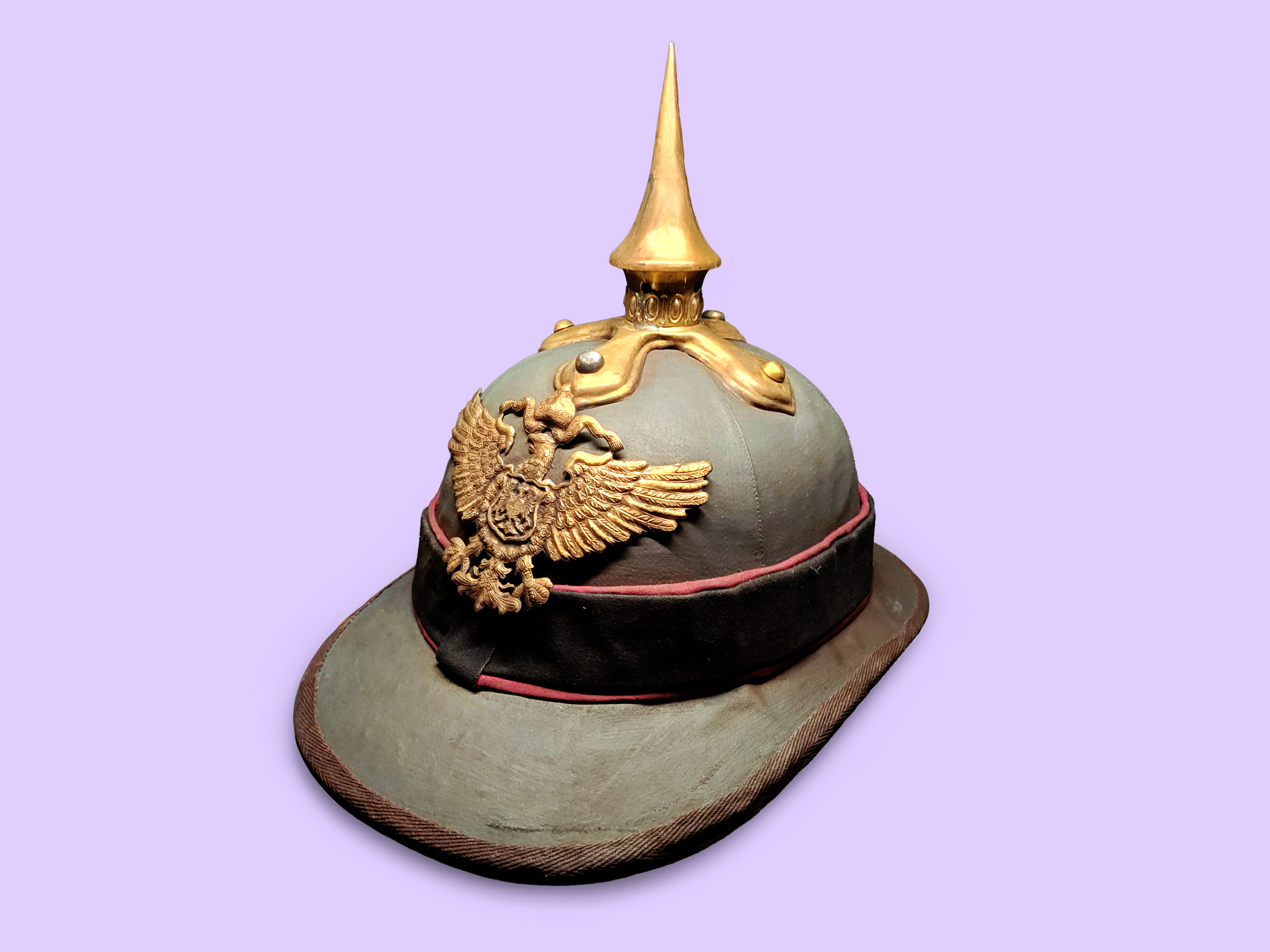
The soldiers of the German East Asian Expeditionary Corps dispatched to China in 1900 to suppress the Boxer Rebellion wore special forms of headgear adapted to the regional climate. The Deutschlandmuseum acquired this colonial Pickelhaube to represent the expedition and the “Hun speech” given by Emperor William II.
The Boxer rebellion and Hun speech
A combination of national disasters and colonial exploitation led to a crisis in China at the end of the 19th century. Sensing that the time was ripe for change, the Chinese nationalist Yihetuan launched the “Boxer Rebellion”, against foreigners in general and Christian missionaries in particular. It acquired its name due to the well-toned, boxer-like, physique of the insurgents, developed through their devotion to traditional martial arts.
An alliance of the United States, Germany, Great Britain, France, Italy, Japan and Russia assembled a military force and dispatched it to crush the uprising. The German contingent was an East Asian Expeditionary Corps assembled for this purpose. During a farewell ceremony for the troops, Emperor William II gave a speech in which he compared the desired effect of the German soldiers to that of the Huns and called on his soldiers to show no mercy. The “Hun speech” severely damaged Germany’s international reputation and the comparison to the Huns featured heavily in anti-German propaganda in the following decades.
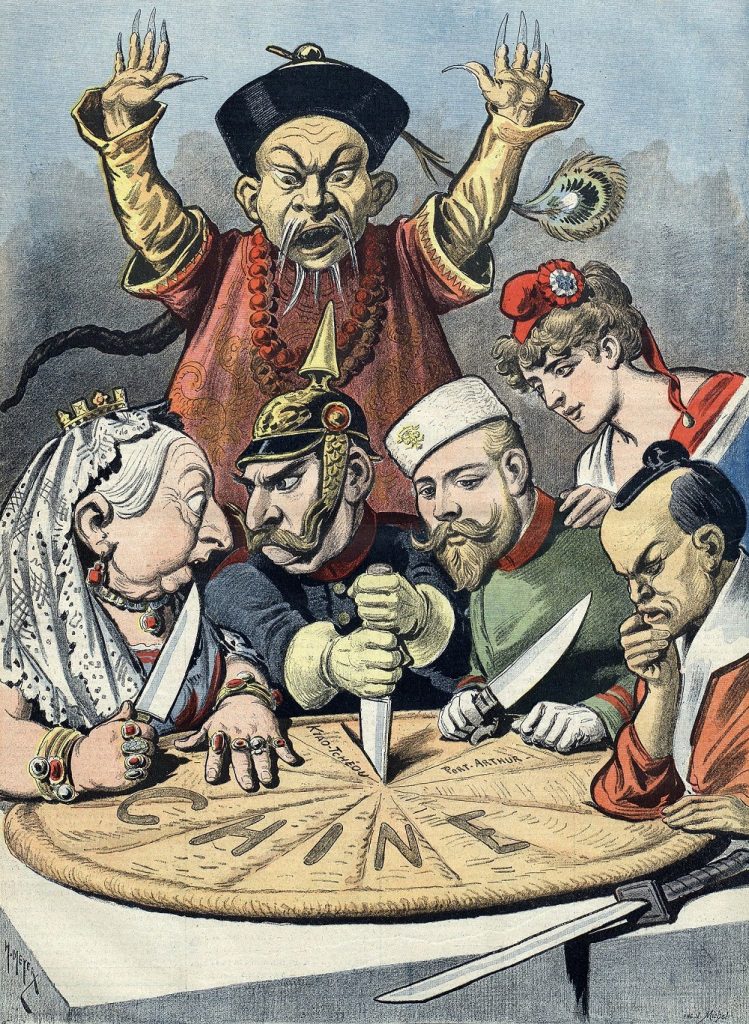
Great Britain, Germany, Russia, France and Japan divide the “Chinese cake” amongst themselves. French caricature from the 1890s (source: Henri Meyer, public domain, via Wikimedia Commons).
The East Asian Expeditionary Corps
The East Asian Expeditionary Corps was formed of 15,000 volunteers drawn from the German regular army. Beijing had already been conquered by the time it arrived in China, so the expeditionary corps mainly carried out punitive expeditions in the surrounding countryside. They followed the instructions of their Emperor and meted out great brutality, even against the civilian population. The Expeditionary Corps reconstituted as the East Asian Occupation Brigade in May 1901.
The helmet issued to the non-commissioned officers of the East Asian Expeditionary Corps on display at the Deutschlandmuseum is an unusual mixture of a conventional colonial pith helmet and the spiked German Pickelhaube. Made of cork with a grey felt cover, it sports a brim that served as a sunshade, a spike and the imperial eagle. It is an extraordinary exhibit from a period in which Germany pursued an increasingly aggressive foreign policy, ultimately leading to the First World War.