The Deutschlandmuseum: A History Museum Like No Other
The Immersive History Museum in Berlin
What do you think of when you hear “German History Museum”? Roped-off exhibits, dusty statues, stone fragments and a lot of boredom perhaps? The Museum of German History is different: it is the only history museum of its kind in Berlin where you can take a journey through 2,000 years of German history. Looking at exhibits through panes of glass? Not at the Deutschlandmuseum – here you can really experience history. A unique blend of interactive history museum and amusement park adventure awaits you.
History, Like You’ve Never Experienced It
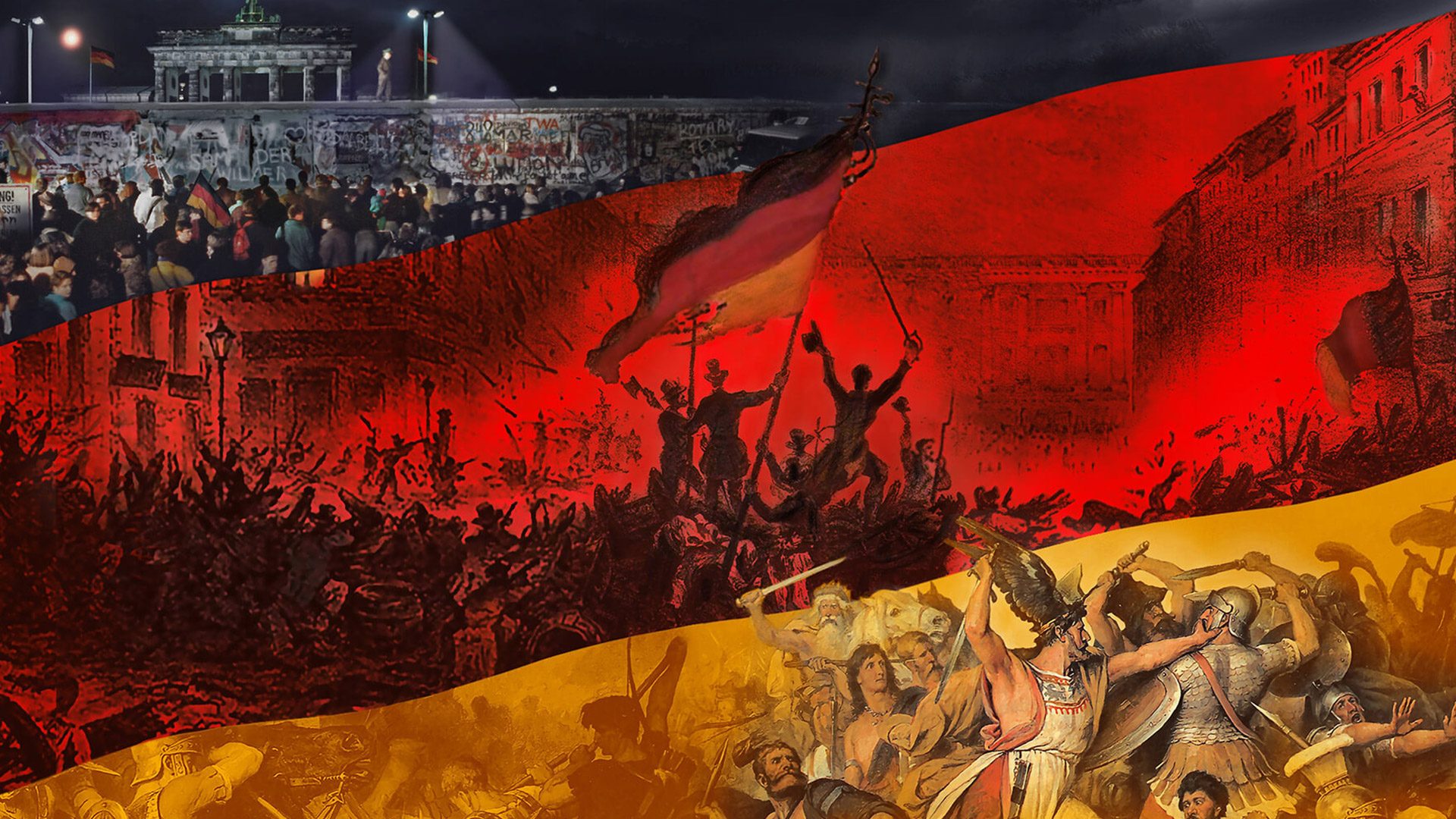
The permanent exhibition of the Deutschlandmusuem covers 1,400 m2 and features twelve pivotal moments from defining eras of German history. All of them are set up as life-size sets in individual sections and are full of intricate details. Interactive media, challenging activities and unique artifacts bring each historical moment to life. You can literally get a grip on German history without the need for prior knowledge – in just one visit and within one hour. The Deutschlandmuseum in Berlin is a history museum that is as exciting as the city itself.
2,000 years of German history
9 AD – Battle of the Teutoburg Forest
An alliance of Germanic tribes led by Arminius destroys a Roman army of almost 20,000 men under the command of Varus. The defeat marks the commencement of the unravelling of Rome’s plans to conquer Germania beyond the Rhine and the Danube.
500 – Foundation of the Frankish Empire
The Franks become the dominant power in Central Europe after the decline of the Western Roman Empire. The Frankish Empire forms the basis for the later development of the French and German nations.
772 – Eastwards expansion of the Frankish Empire
The expansion of the Frankish Empire spreads Christianity amongst the pagan population. Saxon resistance to the new religion provokes a series of bloody wars that eventually end in 804 with the incorporation of Saxony into the empire.
800 – Coronation of Charlemagne
The Pope crowns Charlemagne as emperor in recognition of his political and military dominance. After the fall of the Western Roman Empire, this new form of rule establishes itself as a model for all subsequent medieval European empires.
843 – Division of the Frankish Empire, emergence of East Francia
Rivalries within the Carolingian ruling family lead to the division of the Frankish Empire into three. The polities of East and West Francia established by the Treaty of Verdun later formed the basis of the Holy Roman Empire of the German Nation and of France, respectively.
955 – Battle of Lechfeld
Hungarian raiders have been plundering and ravaging East Francia for decades. The East Frankish King Otto I wins a decisive victory over them at Lechfeld, thereby securing the empire and consolidating his power.
962 – Foundation of the Holy Roman Empire
The coronation of the East Frankish King Otto I as emperor is generally taken as the beginning of the Holy Roman Empire. Staged to resemble the coronation of Charlemagne, the event establishes the tradition of medieval imperial coronations.
1077 – Road to Canossa
After his excommunication following a power struggle with the Pope, Emperor Henry IV needs to ask for forgiveness or lose his crown. Walking barefooted to Canossa and prostrating himself before the Pope, Emperor Henry IV is weakened in the eyes of the nobility. The event becomes a byword for political submission.
1212 – Coronation of Frederick II
Frederick II cedes sovereign rights to the secular and ecclesiastical princes of the empire to secure their support for him as king. This represents a decisive step towards the development of German as a federal polity.
1356 – Golden Bull
A law book with gold seals (bulls) regulates the election of German kings by a defined group of electors. Considered as the central constitutional document of the Holy Roman Empire of the German Nation, it is one of the starting points of European democracy.
1517 – Martin Luther’s 95 theses
Martin Luther publishes 95 theses criticizing the sale of indulgencies by the Roman Catholic Church. Instead of sparking the reform of Church practice, the ensuing discussions divide the Empire and form the starting point for the schism of the Church.
1524 – German Peasants’ War
Economic, social and religious change results in uprisings by discontented German peasants. Articulating their demands in the Twelve Articles of Memmingen, they draft what today is viewed as one of the first declarations of human rights. The uprisings are put down with great brutality.
1618 – Outbreak of the Thirty Years’ War
Religious tensions between Catholics and Protestants and the machinations of power politics culminate in the Thirty Years’ War, which convulses Europe for three decades.
1648 – Peace of Westphalia
The treaties known as the Peace of Westphalia ending the Thirty Years’ War bring religious freedom and a balance of power. The territory of the empire is reduced and the power of the princes grows.
1740 – Coronation of Frederick the Great
The coronation of Frederick II in Prussia marks the beginning of an era of enlightened reforms in society, administration and education. As a successful military commander, Frederick establishes Prussia as a European great power.
1806 – End of the Holy Roman Empire of the German Nation
Defeats in the wars against Napoleon and the secession of numerous principalities weaken the Holy Roman Empire. Under pressure to recognize Napoleon’s power, Emperor Francis II abdicates the imperial crown and dissolves his empire.
1815 – German Confederation
Formed as a loose confederation of 39 German principalities and free cities, the German Confederation is a compromise between the independence of the German states and a desire for national unity. Many view it as a staging post on the road to German national unification.
1848 – March Revolutions
The March Revolutions see citizens demand political freedoms, social reform and national unity. Although the revolution is ultimately crushed, it forces the princes to make lasting political concessions.
1871 – Foundation of Imperial Germany
Formed in 1871, Imperial Germany is the first German nation state. It is the brainchild of Prussian Prime Minister Otto von Bismarck, who assumes the office of Imperial Chancellor.
1914 – The First World War
Nationalism, colonialism and militarism lead to diplomatic tensions and the increasing isolation of Germany within Europe. The assassination of the heir to the Austro-Hungarian throne sparks war.
1918 – Proclamation of the Weimar Republic
Germany’s first parliamentary democracy begins with the proclamation of a republic by politician Philipp Scheidemann on 9 November 1918. As the politicians draft the constitution in Weimar, it becomes known as the Weimar Republic.
1933 – Adolf Hitler appointed Chancellor
A series of political and economic crises lead to the rise of the National Socialist Workers’ Party, culminating in the appointment of its leader, Adolf Hitler, as Chancellor of Germany on 30 January 1933. The National Socialists transform German democracy into a dictatorship within only a few months.
1938 – The Pogrom of 1938
The Third Reich uses the murder of a German diplomat in France by a German Jew as a pretext to launch a wave of anti-Semitic violence throughout Germany. Jewish businesses, synagogues and homes are vandalized, and thousands of Jews are arrested and sent to concentration camps.
1939 – Second World War
Germany’s invasion of Poland on 1 September 1939 violates international law and leads to Great Britain and France declaring war on Germany. Undeterred, Germany invades other European countries.
1942 – Wannsee Conference
Senior Third Reich officials meet at a conference held in Wannsee on 20 January 1942 to plan the systematic murder of European Jews. The results in the genocide of some six million Jews in what later becomes known as the Holocaust.
1945 – Germany’s surrender
The Second World War comes to an end in Europe with the unconditional surrender of the German Wehrmacht on 8 May 1945. The four victorious powers – Great Britain, France, the USA and the Soviet Union – take control of Germany.
1949 – Founding of the Federal Republic and the DDR
Irreconcilable ideological differences between the victorious powers lead to the division of Germany. The Federal Republic of Germany is founded as a parliamentary democracy on 23 May 1949; this is followed on 7 October 1949 by the formation of the German Democratic Republic (DDR) as a socialist state.
1961 – Construction of the Berlin Wall
The DDR orders the construction of an “anti-fascist protection rampart” in Berlin on 13 August 1961. Erected ostensibly to protect the DDR against Western influence, it is really built to end the mass exodus of East Germans to the west.
1972 – Basic Treaty between West Germany and the DDR
West Germany does not recognize the sovereign existence of the DDR until it signs the Basic Treaty, in which both states pledge to accept “peaceful coexistence” with the other. This formed the basis for closer cooperation between the two states.
1989 – Fall of the Berlin Wall
Growing political and social tensions in East Germany generate increasing support for a peaceful protest movement within the DDR. The movement’s call for political reforms puts the DDR government under severe pressure, and a communication error on 9 November 1989 leads to the fall of the Berlin Wall.
1990 – Reunification
The peaceful revolution in the DDR and the fall of the SED dictatorship clear the way for German reunification. After the resolution of the formalities between the victors of the Second World War and the two German governments, East Germany accedes to the Federal Republic of Germany on 3 October.
1992 – Founding of the European Union
The Maastricht Treaty establishes the European Union; this body seeks to foster closer political and economic cooperation between its member states.
2002 – Introduction of the euro as cash
One aim of the EU was to create a common market for goods and services to facilitate trade between EU countries. To this end, a single currency called the euro was introduced in 1999; new coins and banknotes are brought into circulation in 2002.
2006 – “Summer fairy tale”: Men’s Football World Cup in Germany
Even though the home team only came third, nearly all Germans look back fondly on the 2006 World Cup held in Germany. The warm welcome given to the world by vast crowds of enthusiastic Germans unashamedly waving their flags serves to improve the country’s image abroad. Some Germans view the new nationalism with concern.
There are several history museums in Berlin. The German Historical Museum is one of them, as is the GDR Museum. The Deutschlandmuseum is a globally unique type of history museum, having received multiple awards for its innovative approach to presenting history.
There are many museums presenting German history in Berlin. One thing, however, stands out: the Museum of Germany. Because here history can not only be viewed, but experienced with all senses.
The most innovative historical exhibition in Berlin awaits visitors at the Deutschlandmuseum. There you will find 2,000 years of German history from twelve different eras presented in an immersive and interactive way. Unique and incomparable, you can experience history here instead of just looking at it.