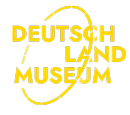

Germany’s most famous film studio begins in a glasshouse
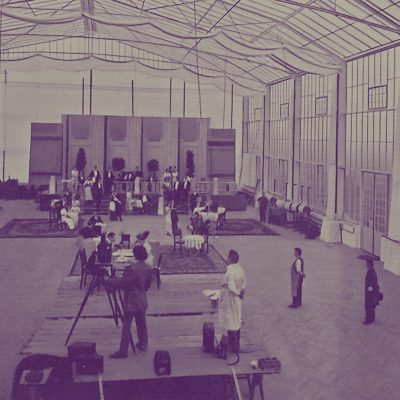
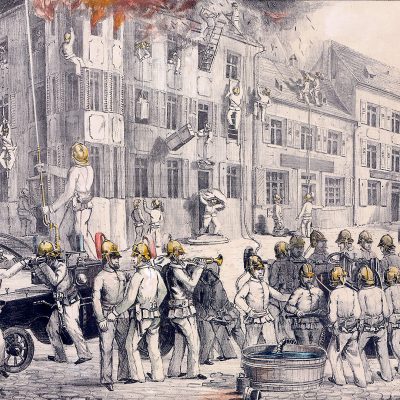
At the turn of the 20th century, the film company Deutsche Bioscope made its films in a rooftop studio in the centre of Berlin. Unfortunately, the spotlights set off the fire alarm so often that the fire brigade suggested that the company relocate to an area outside the city centre. An empty factory in Nowawes – a town that later developed into the Babelsberg district of Potsdam – proved to be the ideal location. A building permit for a glass studio was granted on 3 November 1911, and construction was completed a few weeks later. Workshops, cloakrooms, offices and development laboratories were set up in the factory building. Just a few months later, the first silent film was shot there.
Ten years later, the film company Universum Film AG (UFA) took over the site and built a large studio, where world-famous films such as Metropolis and The Blue Angel were filmed. During the Third Reich, the company produced propaganda films, including the anti-Semitic Jud Süß, as well as entertainment films. After the Second World War, the Soviet military government incorporated the Babelsberg studios into the newly founded Deutsche Film AG (DEFA), which produced hundreds of films, including many popular favourites. Since 1990, huge sums have been invested in further expansion and the creation of a media city. In recent years, a number of international hits have emerged from Studio Babelsberg, including The Bridge of Spies and Babylon Berlin. With over 4,000 films – including Oscar winners – having been made in and around Babelsberg since 1912, it is Europe’s largest film studio and the oldest of its kind in the world.

The whole year at a glance





![Lithografie von Johann Nepomuk Heinemann [koloriert], nach Ölgemälde von Feodor Dietz (Foto: LABW, GLAK)](https://www.deutschlandmuseum.de/wp-content/uploads/2025/02/02031689_Zerstoerung_Heidelbergs-400x400.jpg "Lithografie von Johann Nepomuk Heinemann [koloriert], nach Ölgemälde von Feodor Dietz (Foto: LABW, GLAK)")


![Unter den Unterzeichnern sind die Nobelpreisträger Otto Hahn, Werner Heisenberg und Max Born [digital koloriert] (Quelle: Landesarchiv BW Staatsarchiv Freiburg, CC-BY-SA)](https://www.deutschlandmuseum.de/wp-content/uploads/2025/04/12041957_Göttinger_Erklärung-400x400.jpg "Unter den Unterzeichnern sind die Nobelpreisträger Otto Hahn, Werner Heisenberg und Max Born [digital koloriert] (Quelle: Landesarchiv BW Staatsarchiv Freiburg, CC-BY-SA)")



](https://www.deutschlandmuseum.de/wp-content/uploads/2025/04/21041946_SED_Gründung-1-400x400.jpg "Vereinigungsparteitag von KPD und SPD zur SED [digital koloriert](Quelle: Deutsche Fotothek, CC BY-SA 3.0 DE)")






![Alexander von Humboldt [Ausschnitt], Gemälde von Friedrich Georg Weitsch (Quelle: Alte Nationalgalerie)](https://www.deutschlandmuseum.de/wp-content/uploads/2025/09/14091769_Humboldt-400x400.jpg "Alexander von Humboldt [Ausschnitt], Gemälde von Friedrich Georg Weitsch (Quelle: Alte Nationalgalerie)")



![Albert Einstein im Patentamt Bern, 1905 [digital koloriert] (Quelle: ETH-Bibliothek Zürich)](https://www.deutschlandmuseum.de/wp-content/uploads/2025/09/26091905_Einstein_koloriert-400x400.jpg "Albert Einstein im Patentamt Bern, 1905 [digital koloriert] (Quelle: ETH-Bibliothek Zürich)")